Shopify Automation: Three Integrations Every Store Needs Before It Scales
The automation gaps that kill Shopify stores at scale — order processing, inventory sync, and customer CRM — and how to close them before they become bottlenecks.
The Problem
A Shopify store at 10 orders a day runs fine. At 50, the cracks appear. At 200, they’re gaps — and every gap costs money.
The Shopify admin was built for catalog management and order fulfillment, not for business automation. The moment your store needs to do something Shopify doesn’t support natively — route an order to a specific warehouse based on inventory levels, generate a custom invoice for a B2B customer, sync customer data with your email marketing platform — you’re in manual-workaround territory.
I’ve built integrations for stores at every scale, from a few dozen to several hundred orders a day. Here are the three that matter most — and the architecture behind each.
1. Order Processing Automation
The gap: Orders land in Shopify. Someone manually checks each one, assigns it to a warehouse, updates the status, sends a confirmation email. At 30 orders a day, that’s an hour of clicking. At 100, it’s a full-time job.
The fix: A webhook-driven order pipeline.
Shopify order/paid webhook
        ↓
Express endpoint validates & enriches
        ↓
Route to warehouse (inventory-aware)
        ↓
Update Shopify order status via Admin API
        ↓
Trigger confirmation email (SendGrid / Postmark)
The key architectural decision: process orders asynchronously. Shopify retries if a webhook isn’t acknowledged within 5 seconds, so the endpoint acknowledges instantly and hands the order to a background queue. The queue is idempotent — if Shopify sends the same order twice, it’s processed once, never twice. (For the technical reader: a webhook handler that acks immediately and enqueues with a deterministic job ID per order.)
2. Inventory Sync Across Channels
The gap: You sell on Shopify, but inventory lives in a warehouse system (or another platform, or a spreadsheet). Stock levels drift. You oversell. Customer gets a refund and a bad review.
The fix: A periodic sync with a truth-source database.
Warehouse API → hourly sync → PostgreSQL (source of truth)
                                     ↓
                           Shopify inventory levels updated via REST API
                                     ↓
                           Dashboard shows real-time stock per SKU
Don’t poll Shopify for inventory — use the warehouse as the source of truth. Shopify’s inventory_levels endpoint is rate-limited; batch updates by location.
3. Customer CRM Integration
The gap: Shopify has customers, but no CRM. You can’t see a customer’s full history — orders, support tickets, email opens — in one place. Sales can’t follow up intelligently.
The fix: A customer sync that bridges Shopify to your CRM (or a custom one).
Shopify customer/create webhook
        ↓
Upsert into CRM database
        ↓
Enrich with order history (Shopify API)
        ↓
Segment: VIP / repeat / at-risk (based on recency + frequency)
        ↓
Trigger automated email sequences
The Architecture Pattern
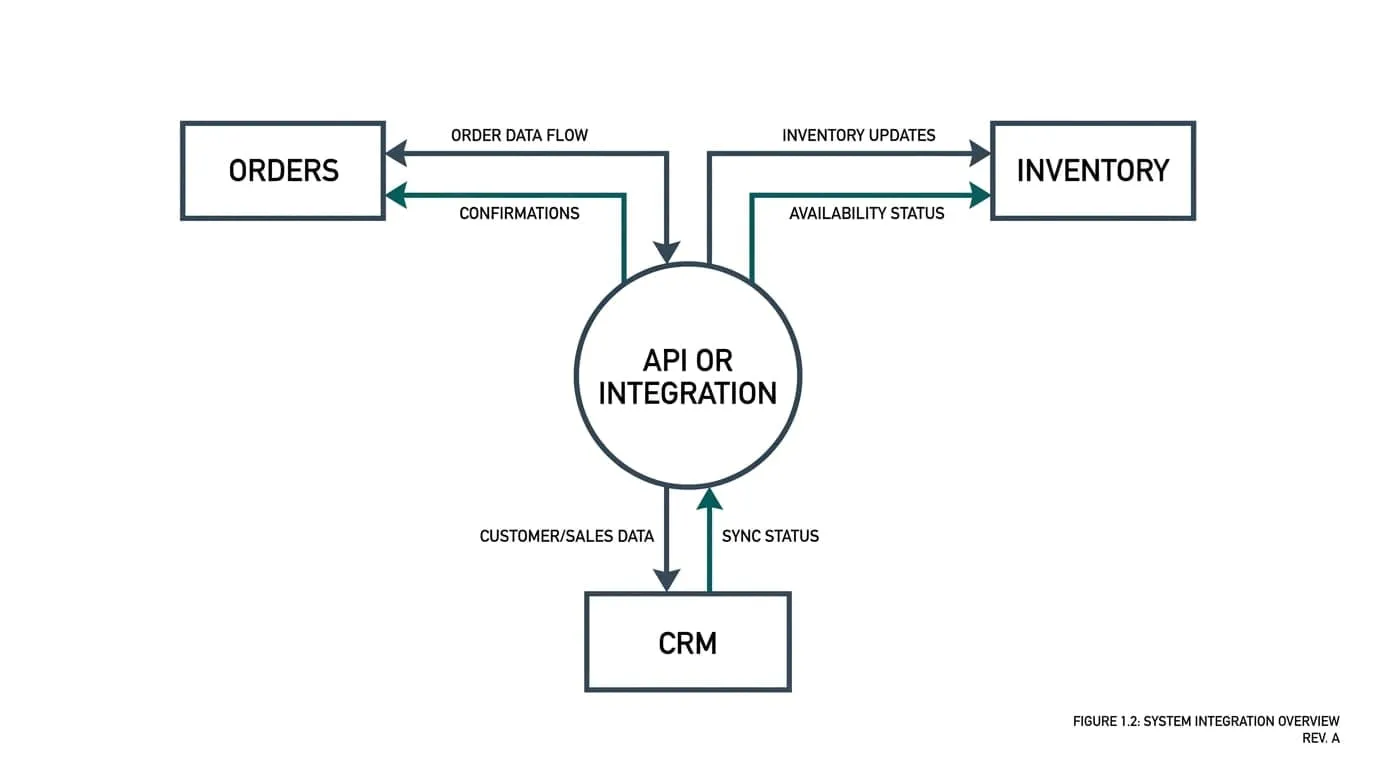
All three integrations share the same skeleton:
- Webhook receiver — acknowledge fast, queue the work
- Idempotency key — Shopify sends duplicate webhooks; your handler must be safe to re-run
- Background worker — process orders, sync inventory, enrich customers off the critical path
- Admin dashboard — a single view of orders, inventory, and customers across all integrations
This is not Shopify-specific. The pattern works for any e-commerce platform with webhooks and a REST API — WooCommerce, BigCommerce, Magento. The business problem is universal; the API is the variable.
TL;DR
| Problem | Shopify admin doesn’t scale past ~50 orders/day — manual processing, inventory drift, no CRM |
| Three integrations | Order automation (webhook + queue), inventory sync (warehouse as source of truth), customer CRM (history + segmentation) |
| Architecture | Webhook → acknowledge fast → queue → background worker → dashboard |
| Key principle | Process asynchronously. Idempotency on every handler. Dashboard for visibility. |
| See also | AppSheet CRM migration case study — consolidating customer history into one system the store owns |
[!IMPORTANT] Running a Shopify store at 50+ orders/day? If manual order processing, inventory drift, or Zapier bills are slowing down your growth, bring them to a 20-minute fit call: we’ll map the target architecture, a realistic timeline, and a scoped estimate — before any commitment. Book a Shopify automation discovery call →