When Google Sheets Stops Scaling
The five signs your business has outgrown Google Sheets — and what to do about it before the spreadsheet breaks.
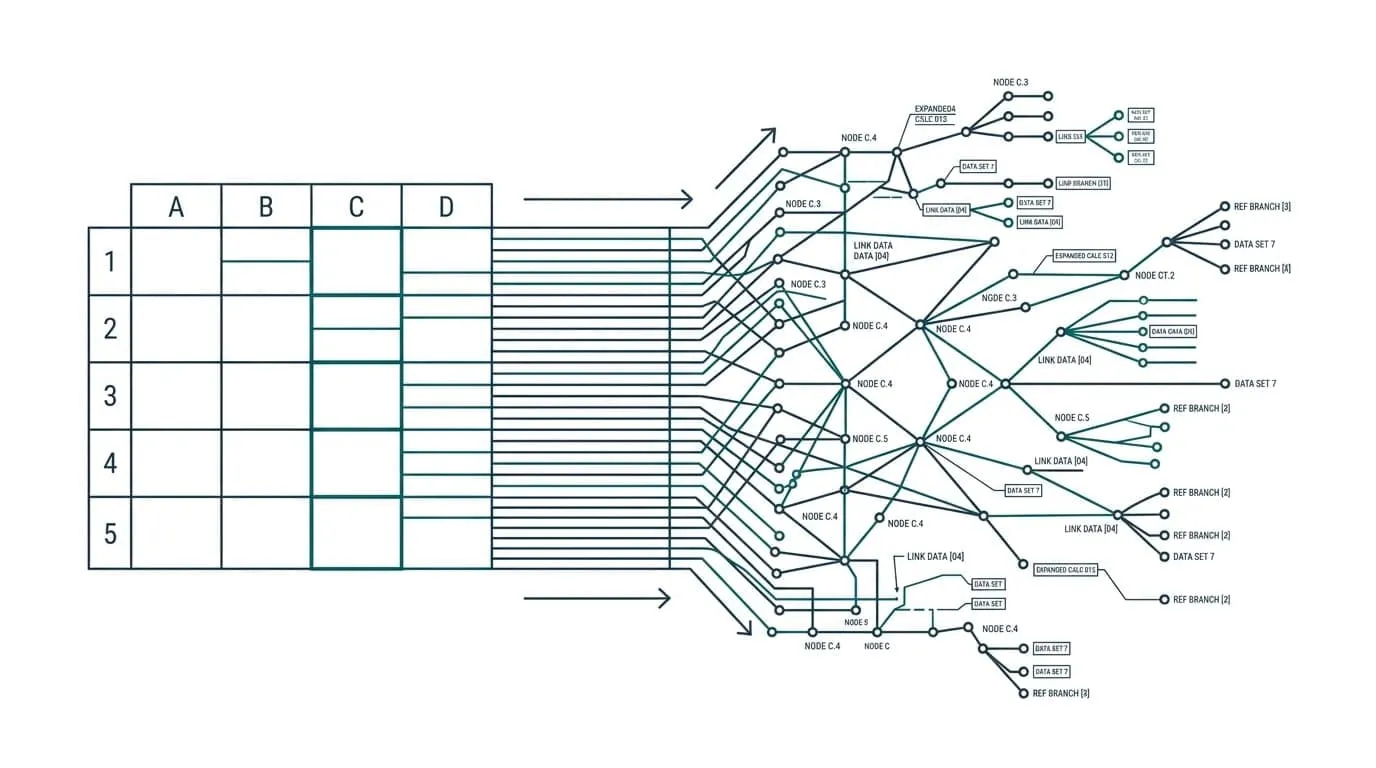
TL;DR
| The problem | Google Sheets at 50k+ rows, VLOOKUP chains, no audit trail, “integration” done by hand |
| Five warning signs | Recalc lag, silent data corruption, multi-user overwrites, copy-paste between systems, reports that take an hour |
| Your options | Stay on Sheets · add AppSheet/Airtable on top · migrate to a real database |
| The safe migration pattern | Automated change-tracked transfer → clean restructured tables → parallel run → automated nightly reconciliation |
| Key takeaway | The sheet that got you from 0→1 won’t get you from 1→10. Migrate before it breaks, not after. |
You’ll learn the concrete signs that Sheets has hit its ceiling, the three realistic next steps (with honest cost/scale tradeoffs), and the migration pattern I use to move a business off Sheets with count-verified reconciliation and zero unplanned downtime.
The Problem
You started with one sheet. Then you added VLOOKUPs. Then IMPORTRANGE across five workbooks. Now someone on the team spends every Friday afternoon reconciling rows because two people edited the same cell. The sheet takes 12 seconds to recalculate. You’ve hit the wall.
I’ve watched this exact cycle in three industries — manufacturing, music distribution, and e-commerce. The tool that got you here will not get you to the next stage, and the longer you push it, the more expensive the eventual migration becomes: the data rots, the formulas multiply, and the “just one more column” workarounds accrete into something nobody fully understands.
Google Sheets is a brilliant prototyping tool and a poor production database. The hard ceiling is 10 million cells per workbook — but in practice you feel the pain at roughly 30,000–50,000 rows with even moderate formulas, long before you approach the limit. If you’re already deleting old rows to make room, you’ve already lost.
For a real-world migration case study (ETL strategy, cutover checklist), see: Migrating an AppSheet CRM to Express + Relational Database.
Five Signs You’ve Outgrown Sheets
Assess your spreadsheet risk level below:
Interactive Google Sheets Risk & ROI Assessor
Assess your spreadsheet health score and estimated weekly wasted time.
1. Row count is the bottleneck
Google Sheets has a hard limit of 10 million cells per workbook. In practice, performance degrades long before that — around 30,000–50,000 rows with even moderate formulas. If you’re deleting old rows to make room, or archiving data into a separate “cold” sheet every month, you’ve already lost. The symptom is a sheet that takes 10–15 seconds to recalculate after a single edit, and a team that has learned to make changes in batches to avoid the lag.
2. Data integrity is manual
No foreign keys. No constraints. No unique indexes. If someone types Acme Corp instead of Acme Corp. in the client column, nothing stops them. Your “database” now has three spellings of the same customer, and every report is suspect.
This is the single biggest hidden cost of running a business on Sheets. A relational database refuses bad data at the door: every customer must have a unique email, an order can’t reference a customer that doesn’t exist, and a required field can’t be left blank. The equivalent protection in Sheets is hoping people are careful.
[!NOTE] What’s under the hood These are one-line database rules — unique keys, required fields, reference checks — enforced automatically on every entry, with no human vigilance required.
Those automatic rules are the difference between a clean customer list and three weeks of cleanup work before you can run a report.
3. Multi-user editing causes silent corruption
Two people open the same sheet. One edits cell B12. The other edits B12 five seconds later. The first edit is overwritten — no warning, no audit trail. You discover it three weeks later when a payment doesn’t match.
Sheets’ collaboration model is optimized for simultaneous presence, not for safety. There is no protection that queues one person’s edit behind another’s, and no practical per-cell audit trail of who changed what, when. For a marketing brainstorm that’s fine. For an order book it’s a liability.
4. Integration means copy-paste or Apps Script glue
The moment you need another system — an ERP, billing software, a customer portal — to read or write your spreadsheet data, you hit the integration wall.
Google Apps Script is fine for small automation. At scale, it’s fragile: execution timeouts at 6 minutes, opaque error logs, no environment variables, no proper deployment pipeline. When your “integration” is an Apps Script trigger that fails silently once a week, you’re running on borrowed time.
5. You can’t answer simple business questions
“What was our net margin per customer segment last quarter?”
If answering that requires opening three workbooks, copying columns, running a VLOOKUP, and hoping no rows were filtered out, your reporting has failed. A proper database answers that in one saved report, in milliseconds, every time.
Three Options When Sheets Stops Scaling
When you hit the wall, you have three realistic paths forward. Each has different costs, timeline, and longevity.
| Path | Best for | Typical cost | Operational overhead | Longevity |
|---|---|---|---|---|
| 1. Stay on Sheets + clean up | Teams under 15k rows, single time zone | $0 | High (constant maintenance) | 3–6 months |
| 2. Low-code (AppSheet / Airtable) | Quick field apps, no developer available | $10–30/user/mo | Medium (vendor lock-in) | 1–2 years |
| 3. Real Database (SQL + API) | Core business ops, multi-system integration | $20–50/mo hosting + build cost | Low (automated & typed) | 5+ years |
Path 1: Clean up and stay (temporary patch)
If you’re at 20,000 rows and just need breathing room:
- Replace
VLOOKUPwithINDEX/MATCHorXLOOKUP(significantly faster in Google Sheets). - Remove unused formatting — conditional formatting across thousands of cells is the #1 silent recalculation killer.
- Move historical data (>1 year old) to an archive sheet, keeping the active sheet under 20,000 rows.
This buys 3–6 months. It doesn’t solve data integrity or multi-user overwrites.
Path 2: Low-code wrapper (AppSheet / Airtable)
If you have no developer and need mobile/field entry quickly, AppSheet or Airtable provides a real UI on top of your data.
- AppSheet works natively over Google Sheets. It adds form validation and role-based views.
- Airtable replaces the spreadsheet entirely with a relational-like interface.
The trade-off: Per-user pricing scales steeply ($10–$30/user/month). At 20 users, you’re paying $200–$600/month for a tool that still lacks full relational power and raw query access. For a deeper breakdown, see Migrating an AppSheet CRM to Express + Relational Database.
Path 3: Custom Database + API (the permanent fix)
This is the path for core business operations: orders, inventory, billing, customer data.
You move the data into a relational database, put a proper application layer in front of it, and build a clean web interface (or connect your existing tools).
- Data integrity is enforced by the database itself — duplicate customers, orphaned records, and invalid entries are rejected automatically.
- Concurrent edits are handled safely — two people can’t silently overwrite each other’s work.
- Queries take milliseconds, regardless of table size (millions of rows).
- Cost flattens: hosting a database + API costs $20–$50/month flat, whether you have 5 users or 50.
The Safe Migration Pattern
The #1 fear teams have about leaving Sheets is data loss or operational disruption. The migration pattern I use is designed to remove both by running the old and new systems in parallel: the team keeps working in Sheets while an automated job copies every change into the new database each night, and a second job compares the two systems for drift.
Step 1: Schema design (normalize first)
Don’t copy the sheet structure 1:1. Spreadsheets combine entities into flat rows; relational databases split them into clean tables.
A single Orders sheet with customer name, address, line items, and payment status becomes three normalized tables: customers, orders, and order_items.
Step 2: Automated transfer with a change checkpoint
The transfer job reads from Sheets and writes to the relational database. It tracks where it stopped (a change checkpoint), so re-running it is always safe: running it twice produces the exact same state as running it once. Bad data is stopped and reported — never silently copied — and no record can be duplicated.
Step 3: The shadow run (2–4 weeks)
The team continues working in Google Sheets. Every night, the transfer job syncs changes to the database. An automated audit job compares the two systems record by record.
When the audit job reports 0 drift for 14 consecutive days, you know the new system is 100% faithful to the source.
Step 4: Cutover
Flip the switch: the new web app becomes the primary interface. Google Sheets is set to read-only for two weeks (as a safety net), then archived. Zero downtime, zero lost rows.
Summary Checklist
- Audit your sheets: identify workbooks over 30k rows or with >10 concurrent editors.
- Check error rates: count how many times bad data (typos, orphaned rows) required manual cleanup last month.
- Choose your target: AppSheet for quick field apps; SQL database + API for core business operations.
- Use parallel-run migration: never do a “big bang” cutover from a spreadsheet.
Outgrown your Google Sheets?
I help businesses migrate from fragile spreadsheets to production database systems — using a backup-first, parallel-run method designed for zero-downtime cutover, with row-level reconciliation before anyone switches over.